How to Archive iMessage for Business Compliance
Your people do business on iMessage. Clients and constituents text the blue bubble because it is fast and it is where they already are. But a business message is a record, no matter which app carried it, and Apple Messages are notoriously hard to keep.
So the real question is not whether iMessage belongs in your records. It is how to capture and archive it in full, without forcing anyone off the app they already use.
The short answer
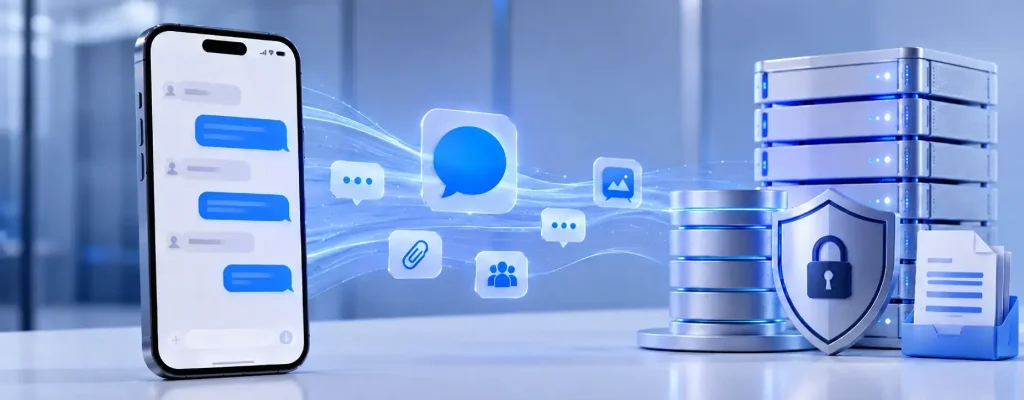
To archive iMessage for business, you capture each message at the device level, convert it to a durable record, and deliver it into your compliance archive. Done right, capture pulls in iMessage in full fidelity, the text, media, attachments, reactions, and emojis, with no app to install and no change to how people text. The result is a complete, searchable record of business conversations, kept in the archive you already run.
A firm or agency cannot preserve what it never captured, so iMessage archiving starts with capture.
Why iMessage is so hard to archive
Here is the catch that trips up most teams. iMessage is not standard texting. It is Apple’s own encrypted service, so the messages do not flow through the carrier the way an old SMS did. A carrier-level capture misses them entirely.
Naturally, people reach for the blue bubble anyway, because it is the smoothest way to reach someone. And when the easy channel is the uncaptured one, your record quietly develops a hole, not through bad intent, but through ordinary habit. The exposure comes from a channel you could not see, not from a bad actor.
You can archive iMessage without changing how people text
Here is the good news. You do not have to ban iMessage or hand everyone a new phone to stay compliant. We capture iMessage and RCS natively, right where the conversation happens, with no app to install and no change to the texting experience your people expect.
Blue bubbles, reactions, media, and attachments are all included. We are carrier-agnostic, which suits distributed and international teams, and we support both corporate-owned and personal devices. The only open question is which setup fits your environment, and a Solutions Team expert maps the right one with you on a quick call.
How iMessage archiving works
The mechanic is deliberately simple, so it earns the adoption a complete record depends on.
We capture the message.
Capture runs at the device level and pulls in business iMessage, RCS, and SMS in full fidelity, including media, attachments, reactions, and emojis. There is no third-party app changing how your people text. Setup is light: after a done-for-you provisioning step, the user finishes a roughly seven-minute, three-step onboarding. Channel-health monitoring then watches the connection and alerts the user and admin if it ever drops, for example after an Apple ID password change, so capture stays complete.
We convert it to a usable record.
Every captured message becomes an email-format record. The subject line flags the message type, iMessage or SMS, so a search can be scoped to mobile in seconds. The To and From line shows the participant numbers, with the employee side enriched with their name and corporate email. Behind the scenes, data moves over TLS 1.2, with no message data kept at rest in our system.
We deliver it to your archive.
This is the part a single-archive product cannot cleanly match. We are archive-agnostic. We deliver captured iMessages into industry-leading archives like Intradyn, or any other you already run. Nothing to rip out, nothing to refit. You can even deliver to more than one archive for redundancy. Your reviewers work where they already work.
Keeping business and personal separate
On a personal device, privacy is the whole game. Where you need business-only coverage, selective and whitelist capture pulls in business conversations and leaves personal messages untouched. You can scope capture by number, by a group’s name, or by any group that includes a business contact. People keep their privacy, and your organization keeps its records, which is exactly what keeps adoption high.
One honest note on device options. The native capture described here is what brings iMessage into your record. A separate business-number app, used by some teams for personal phones, captures business SMS rather than iMessage, so match the method to the people and the channels you actually need.
Why this matters: the rules behind iMessage archiving
Archiving iMessage is not a nice-to-have for a regulated organization. It is how you meet rules that already apply to every business communication.
For financial firms
Business communications are records regardless of the device or app used to send them, so a business text is a record like any business email. The SEC’s electronic-recordkeeping standard, modernized by the 2022 amendments, sets how those records are preserved, explained in the SEC’s amendment guide and carried in the rule text. FINRA Rule 4511 pulls that standard into the FINRA rulebook with a default retention of at least six years (see our FINRA 4511 retention guide). Investment advisers carry parallel recordkeeping obligations, and other applicable recordkeeping, retention, and supervision regulations reach the same conclusion.
The urgency here is real, and worth stating calmly. Since 2021, regulators have charged more than 100 firms and collected over $3 billion in penalties for recordkeeping failures tied to off-channel communications. In one action in August 2024, the SEC charged 26 firms with more than $390 million in combined penalties, detailed in its press release. Regulators have pointed to firm-approved, captured messaging as the remedy. The lesson is not to ban mobile. It is to capture it properly.
For government and public agencies
A public official’s text messages about public business are public records, subject to retention and disclosure like any other record. At the federal level, the Freedom of Information Act gives the public an enforceable right to request agency records. Every state, and most counties and cities, has its own version through Sunshine, public-records, right-to-know, and FOIL laws. They differ on the details, but they share one principle: government communications on mobile devices, including iMessage, are public records an agency must be able to retain and produce.
So whether the driver is securities recordkeeping or an open-records request, the answer is the same. Capture the message, and keep it where you can find it.
How to archive iMessages on an iPhone
For an individual wondering how to save a thread, iOS lets you keep messages on the device and adjust how long they are stored in Settings, and you can save a copy by taking screenshots. That is fine for personal memory. It is not a compliance record. It can be deleted, it is not centrally preserved, and it cannot be searched or produced across a team. Business archiving works differently. It captures every business iMessage automatically, off the device, and lands it in your archive, so the record does not depend on any one person remembering to keep it.
The bottom line
Before, business iMessages lived on personal phones, easy to send and impossible to produce, out of step with the rules that govern your records. After, every business iMessage is captured in full, converted to a usable record, and delivered into the archive you already trust.
Your people keep texting the way clients and constituents expect. Your privacy stays intact where it should. And your organization keeps the complete record it is responsible for. Capture runs about a third the cost of an iPhone, and the right fit is the only thing left to map.
This article is general information and education only, not legal or compliance advice. FINRA and SEC requirements change, and how they apply depends on your firm and situation. Confirm current obligations with your own qualified compliance or legal counsel and the primary regulations before you act.
FAQ’s
Archive iMessage FAQ
Can you archive iMessages from an iPhone?
Yes. Business iMessages can be captured at the device level and delivered into a compliance archive automatically, in full fidelity, without anyone manually saving threads. That is what turns a personal chat history into a complete, searchable business record.
Does archiving iMessage change how my team texts?
No. Capture runs natively, with no third-party app and no change to the texting experience. Blue bubbles, reactions, and media all come through, so adoption stays high.
Can I archive business iMessages but not personal ones?
Yes. Business-only whitelist capture lets you scope capture by number or group, so business conversations are recorded while personal messages stay private. That separation is what makes capture work on personal devices.
Do archived iMessages go into my existing archive?
Yes. We are archive-agnostic. Captured messages are converted to an email-format record and delivered into the archive you already run, like Intradyn or any other, so there is nothing to rip out or refit.
Why do regulated firms and agencies need to archive iMessage?
Because a business message is a record regardless of the app. Financial firms must preserve business communications under the SEC standard and FINRA Rule 4511, and public agencies must retain and produce public records under the Freedom of Information Act and state public-records laws. Active enforcement, like the SEC’s August 2024 action, makes the point hard to ignore.
Start The Conversation
See the easily adopted, flexible, and affordable options.
Business-only, audit-ready mobile capture for any firm size, any device type, and any budget.
Related Guides
Compliance and capture guides
These guides go deeper on the rules, enforcement, and capture methods behind iMessage archiving, so you can see why the record has to be captured and how the pieces fit together for financial firms and public agencies alike.
- Broker-dealer compliance The hub guide to a firm’s full recordkeeping duty, and where captured iMessage fits in.
- FINRA 4511 retention requirements The books-and-records rule and the default six-year retention period that makes archiving mandatory.
- SEC 17a-3 and 17a-4 recordkeeping How the SEC’s rules create and preserve records, and what the 2022 amendments changed for electronic formats.
- FINRA 3110 supervision Why supervision means you have to capture mobile messages before you can review them.
- Off-channel communications The enforcement backdrop behind why uncaptured iMessage is a records gap.
- RIA compliance for texting How the same recordkeeping duty reaches registered investment advisers.